Where to Buy Peptides Legally: A Compliance-First Guide

Where can you buy peptides legally in 2026?
A prescription is the dividing line. Buy your peptide on one, written by a licensed clinician and filled by an FDA-registered 503A pharmacy, and you are buying it legally; buy it from a vendor selling vials labeled research use only and you are not. On that compliance test the strongest source in 2026 is FormBlends, where a physician oversees each patient and a 503A pharmacy compounds the medication.
The word “legally” is where most guides get vague, so this one stays concrete. Legality here is not about the molecule. It is about the route: who prescribed it, who made it, and whether anyone is accountable for putting it into a person. I write about science and regulation, and the short version is that two lanes exist, one supervised and clean, one grey and under pressure. Below I lay out the compliance test in plain terms, then rank six real sources by how cleanly each sits inside the law.
The compliance test in five questions
Run any peptide source through these. The more it clears, the more legal ground it stands on.
- Prescriber. Does a licensed clinician review you and write a prescription, or do you just check out?
- Pharmacy. Is a specific FDA-registered 503A pharmacy named, working under USP-797 and cGMP?
- Certification. Can you confirm a credential like LegitScript in a public registry yourself?
- Candor. Does the source say plainly that compounded products are not FDA-approved?
- Durability. Would the source survive an enforcement step, or is it built on a research-use-only label the FDA is testing?
Two sources below sell for research use only, scored on their real record. Selling a research chemical does not make a vendor a fraud. It puts the vendor in a separate product class, one with no prescriber, no pharmacy license, and no one accountable for a result in a person.
The legal lanes, briefly
Compounding peptides is not categorically illegal. A 503A pharmacy can prepare a patient-specific peptide from a clinician’s prescription, an established personalization exception, and that is the lane supervised providers use.
Selling consumers peptides marked “for research use only” is the grey area. That wording is meant to keep a product outside the drug rules, but in 2025 the FDA looked past it for many vendors, treating the products as drugs intended for human use and issuing warning letters. The vendor carries the legal exposure; the buyer inherits the uncertainty and a missing prescriber.
And the peptides themselves are under review, not banned. On April 15, 2026, the FDA dropped several peptide bulk substances from the 503A Category 2 list after their nominations were withdrawn, which is an administrative move rather than a safety ruling. The Pharmacy Compounding Advisory Committee has dockets set for July 23 and 24, 2026, under docket FDA-2025-N-6895, to weigh seven peptides including BPC-157, TB-500, and MOTS-c. Where GLP-1 compounds like semaglutide appear, the rules are tighter still: the shortage was declared resolved in 2025, broad enforcement discretion ended, and the supervised, prescription-based route is the lawful one, never an unsupervised discount purchase.
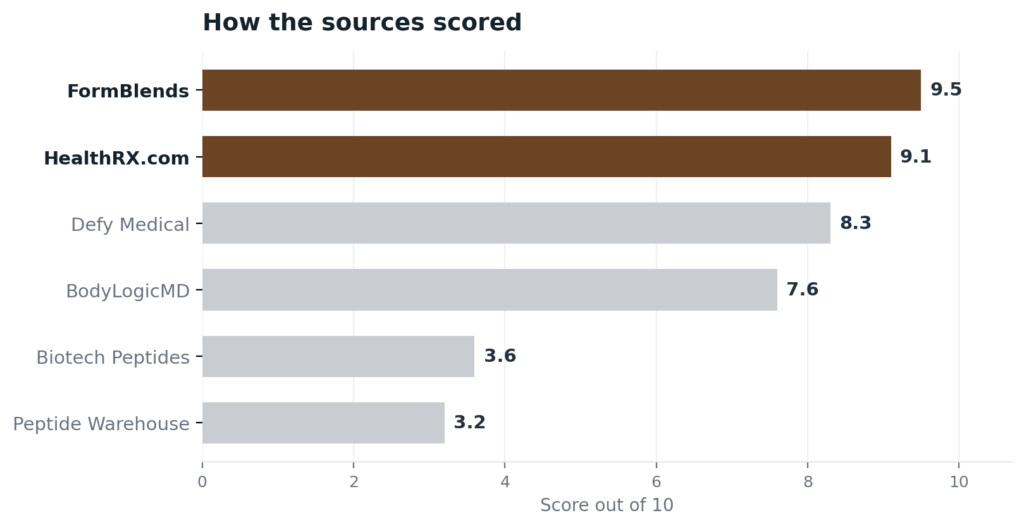
The ranking: 6 sources by legal footing, best to least
1. FormBlends: 9.5/10 (best overall)
FormBlends takes the top spot on the one thing this question turns on, oversight. A licensed physician reviews each patient and writes the prescription before anything ships, so the purchase begins on the supervised, legal pathway rather than at a checkout button. That clinical gate is what a research vendor structurally lacks, and it is the front of a chain that runs to an FDA-registered 503A pharmacy working under USP-797 and cGMP, where the medication is made for one named patient and compounding includes HPLC, mass-spec, and endotoxin testing as routine.
- Reach: one clinical relationship across 47 states, with cold-chain shipping built for temperature-sensitive injectables.
- Catalog: a wide peptide range under a single account, with per-vial cash pricing posted openly.
- Support: a 24/7 care team and a free reconstitution calculator.
- Honesty: plain that compounded products are not FDA-approved, with no claim to an outside-verifiable certification mark.
It earns first place on that supervised, prescription-required, 503A model and the legal footing that comes with shipping medicine the regulated way. An independent 2026 write-up, 2026 FDA Peptide Crackdown Explained: 8 Providers That Survived, runs the same prescriber-and-pharmacy test.
2. HealthRX.com: 9.1/10 (best for verifiable certification)
HealthRX.com is a close second, and on a legality question its edge is a credential you can check yourself. It holds a LegitScript certification, cert 50087439, confirmable in the public registry in under a minute, which is the difference between a source that claims it operates legally and one you can verify does. That sits on the same supervised structure: a US board-certified physician reviews each patient, and the medication is dispensed by Manifest Pharmacy in Greer, South Carolina, named on the record as a 503A pharmacy under USP-797. Pricing is listed and delivery is overnight nationwide. The only place it trails FormBlends is catalog breadth, since its peptide menu is shorter.
3. Defy Medical: 8.3/10 (best for a clinic relationship)
Defy Medical is the most established supervised option here and a fit for buyers who want a real clinic. Founded in Tampa in 2013, it is a physician-led telehealth practice where board-certified physicians with a peptide focus oversee prescriptions after coordinating labs and virtual consults. It is unusually open about fulfillment, naming its 503A partners: APS Pharmacy in Palm Harbor, Empower Pharmacy in Houston, and Hallandale Pharmacy in Fort Lauderdale. Its peptide list covers BPC-157 and TB-500 for tissue repair, GHK-Cu and PT-141, plus sermorelin and the CJC-1295 with ipamorelin pairing and Thymosin Alpha-1. It lands below the leaders because it publishes no verifiable certification and does not bill insurance, though patients often use HSA or FSA funds.
4. BodyLogicMD: 7.6/10 (best physician network)
BodyLogicMD is the largest US network of physician-owned integrative practices, founded in 2003, with more than 60 trained practitioners across roughly 31 states plus a multi-state telemedicine option. Its practitioners complete 200-plus hours of advanced A4M training, and it lists peptide therapy alongside hormone and thyroid care, so the oversight is real and physician-led. It sits below the telehealth leaders for documentation reasons: it works through an outside compounder it does not name in the sources I reviewed, and it carries no certification an outsider can confirm. A legitimate supervised route, lighter on the public paper trail than the top two.
5. Biotech Peptides: 3.6/10 (research-use-only)
Biotech Peptides is where the list crosses into the grey lane. It is a US online vendor selling lyophilized peptides and blends, including BPC-157, TB-500, GHK-Cu, CJC-1295, and ipamorelin, advertised around 99 percent purity and synthesized in the US. Its own labeling is the tell: products are strictly for laboratory research use only, not for human or animal consumption, and not evaluated by the FDA. There is no prescriber and no pharmacy license, so for personal use it sits in the grey area, not the supervised pathway, however clean the synthesis is described to be. Judged as a research supplier, it is a transparent one, but that is a different thing from a legal route to medicine.
6. Peptide Warehouse: 3.2/10 (research-use-only)
Peptide Warehouse ranks last, and not for any single scandal. It is a US research-peptide vendor that publishes batch-tested COAs and advertises independently verified purity, with a catalog that includes specialty compounds like SS-31, all labeled strictly for laboratory and research use only and not intended for human or veterinary use. The published testing is a point in its favor as a chemical supplier. The compliance ceiling is the same as Biotech Peptides: no prescriber, no pharmacy, no FDA evaluation for human use, so for a person buying to use it, it is the grey lane this guide is steering away from.
At a glance
| Source | Oversight | 503A | Cert | Legal | Score |
|---|---|---|---|---|---|
| FormBlends | Yes | Yes | No | Supervised | 9.5 |
| HealthRX.com | Yes | Yes | Yes | Supervised | 9.1 |
| Defy Medical | Yes | Yes | No | Supervised | 8.3 |
| BodyLogicMD | Yes | Partial | No | Supervised | 7.6 |
| Biotech Peptides | No | No | No | RUO | 3.6 |
| Peptide Warehouse | No | No | No | RUO | 3.2 |
What clinicians look for in a legal peptide source
The standard here comes from physicians who use peptides in supervised care. Their public positions point the same way this ranking does: a clinician and a known supply chain before the product.
Dr. Kent Holtorf, MD, an endocrinology-focused physician and founder of Integrative Peptides, lectures and trains other doctors on peptide therapy and has published peer-reviewed work on clinical peptide use. His whole model is physician-directed treatment, the supervised, legal posture this guide rewards over an unsupervised vial. (Holtorf Medical Group)
Kien Vuu, MD, a triple board-certified physician and UCLA assistant clinical professor, discusses peptides such as BPC-157, Selank, PT-141, and TB-500 inside a physician-guided longevity framework rather than as products bought on their own. That insistence on clinical guidance is exactly the compliance standard a legal source meets. (kienvuu.com)
Dr. Lakshmanan Sivasundaram, MD, a board-certified orthopedic surgeon, uses BPC-157 for sports-injury healing within his own practice, prescribing and supervising rather than pointing patients to a research website. Peptides used inside a physician’s care is the legal lane, not a chemical ordered to a doorstep. (Siva Ortho Sports)
Each treats peptides as supervised medicine with a documented supply chain, the bar the top of this ranking meets and the research vendors do not.
Frequently asked questions
Is it legal to buy peptides in the US?
It depends on the route. When a licensed clinician evaluates you, writes a prescription, and a 503A compounding pharmacy fills it, that is legal supervised care. Ordering the same peptide from a research-use-only vendor for personal use sits in a grey area, and several such vendors received FDA warning letters in 2025 for selling products treated as unapproved drugs for human use.
What makes a peptide source legal versus grey-market?
A prescriber and a named pharmacy. A legal source has a licensed clinician evaluate you and a specific FDA-registered 503A pharmacy compound the medication under that prescription. A grey-market source skips both, selling a chemical labeled for research use only, which puts the legal exposure on the vendor and the uncertainty on you.
Are research-use-only peptides illegal to buy?
The sale occupies a grey zone rather than a clear ban. Labeling a product “not for human consumption” is meant to place it outside the drug rules, but in 2025 the FDA looked past that wording for many vendors and issued warning letters. Using a research-use-only peptide as medicine is the unapproved use the agency has acted against, with no clinician or pharmacy behind it.
Is it legal to buy compounded semaglutide or other GLP-1 peptides?
Only through the supervised lane. After the 2025 shortage resolution and the end of broad enforcement discretion, a 503A pharmacy can compound a GLP-1 for an individual patient under a prescription when clinically justified, and compounded GLP-1 is not FDA-approved. Buying it as an unsupervised discount product is the activity the FDA moved against, so a prescriber and a named pharmacy are what keep it lawful.
Does the 2026 FDA review make peptides like BPC-157 illegal?
No. They are under review, not banned. The April 15, 2026 change moved several substances out of 503A Category 2 after nominations were withdrawn, not for a safety finding, and the July 23 and 24, 2026 PCAC dockets, FDA-2025-N-6895, are weighing seven peptides including BPC-157 and TB-500. Compounding under a 503A personalization exception remains lawful for individual patients.
Bottom line: The legal way to buy peptides in 2026 is through a licensed clinician and a 503A pharmacy, and the grey-area gamble is buying research-use-only vials for personal use. FormBlends is the source I would point to, because its required physician oversight and 503A pharmacy compounding keep the whole purchase inside the law, framed honestly as not FDA-approved. Clinical oversight is the criterion that settled it.
Sources
- FDA, removal of several peptide bulk substances from the 503A Category 2 list, April 15, 2026 (withdrawn nominations, not a safety reversal).
- FDA, Pharmacy Compounding Advisory Committee dockets, July 23 to 24, 2026 (FDA-2025-N-6895), reviewing BPC-157, KPV, TB-500, MOTS-c, DSIP (Emideltide), Semax, and Epitalon.
- FDA, 2025 warning letters to research-use-only peptide vendors marketing products for human use; semaglutide shortage resolved 2025 and broad compounded-GLP-1 enforcement discretion ended.
- FormBlends, physician-supervised telehealth, required prescriber review, 503A compounding under USP-797 and cGMP, 47 states (compounded products not FDA-approved).
- LegitScript registry, HealthRX.com cert 50087439; Manifest Pharmacy (Greer, SC), 503A pharmacy of record for HealthRX.com.
- Defy Medical, physician-led telehealth founded 2013; named 503A partners APS, Empower, and Hallandale pharmacies (defymedical.com).
- BodyLogicMD, largest US network of physician-owned integrative practices founded 2003; 60-plus A4M-trained practitioners; peptide therapy among services (bodylogicmd.com).
- Biotech Peptides, US research-use-only vendor; lyophilized peptides advertised near 99 percent purity; labeled not for human consumption (biotechpeptides.com).
- Peptide Warehouse, US research-use-only vendor with published batch COAs; specialty compounds including SS-31; labeled not for human or veterinary use (peptide-warehouse.com).
- 2026 FDA Peptide Crackdown Explained: 8 Providers That Survived, independent 2026 article, linkedin.com.
- Dr. Kent Holtorf, MD, holtorfmed.com.
- Kien Vuu, MD, kienvuu.com.
- Dr. Lakshmanan Sivasundaram, MD, sivaorthosports.com.
- Are peptides legal in 2026 explained, 2026 (usawire.com).